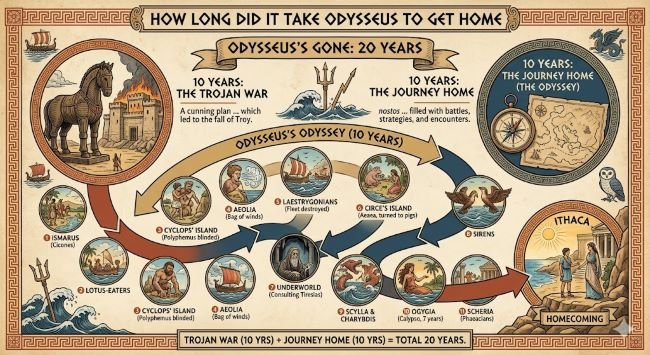
If you’ve ever asked how long did it take Odysseus to get home, the short answer is 20 years. Ten of those were spent fighting in the Trojan War. The other ten were the journey itself, a decade of monsters, gods, temptation, and near-death experiences that kept him from reaching Ithaca. That’s a long time to be away from home, and the Odyssey spends considerable effort making sure you understand exactly why each delay happened. This post walks through the full timeline, the major stops, and what the journey reveals about the values Homer built into the poem.
When Was the Odyssey Written and Where This Story Comes From
Before getting into the journey itself, a quick note on the source. The Odyssey is an ancient Greek epic poem attributed to Homer. Scholars place its composition somewhere around the 8th century BCE, though the stories it contains are much older, drawn from oral traditions that circulated for centuries before anyone wrote them down.
The poem picks up after the fall of Troy and follows Odysseus as he tries to return to Ithaca, his kingdom, where his wife Penelope and son Telemachus have been waiting. It’s one of the foundational texts of Western literature, and the journey at its center has been retold, adapted, and referenced so many times that most people know the broad strokes even if they’ve never read the original.
The Odyssey Summary: 20 Years in Two Parts
The 20-year absence breaks cleanly into two phases.
Phase one: The Trojan War (10 years)
Odysseus was one of the Greek leaders who sailed to Troy to retrieve Helen, whose abduction by the Trojan prince Paris had triggered the war. The conflict lasted a decade. Odysseus played a central role in the Greek victory, most famously by devising the Trojan Horse strategy that finally broke through Troy’s defenses. When Troy fell, the Greeks began sailing home. That’s where phase two begins.
Phase two: The journey home (10 years)
The Odyssey covers this second decade. Odysseus and his men set sail from Troy, and what should have been a relatively straightforward voyage turned into ten years of wandering. The poem opens near the end of this period, with Odysseus stranded on the island of Calypso, seven years into his journey, before he finally makes it home.
Why Did It Take Odysseus 10 Years to Get Home?
The delays weren’t random. Each one came from a specific cause, whether a divine enemy, a poor decision, or a trap he couldn’t immediately see.
The Cicones: After leaving Troy, Odysseus and his men raided the island of the Cicones. They won the battle but stayed too long celebrating, and the Cicones returned with reinforcements. Odysseus lost six men from each ship before they escaped. It was a preventable loss caused by not leaving when they should have.
The Lotus Eaters: A brief stop on an island where some of the crew ate lotus flowers and lost all desire to return home. Odysseus had to drag them back to the ships by force.
The Cyclops Polyphemus: This is one of the most famous episodes. Odysseus and his men were trapped in the cave of Polyphemus, a Cyclops who began eating the crew. Odysseus blinded him to escape, but made the mistake of taunting the Cyclops and revealing his real name as they sailed away. Polyphemus prayed to his father Poseidon to curse Odysseus. Poseidon, god of the sea, answered that prayer. This is the single biggest reason the journey took so long: a god actively working against him for the rest of the voyage.
Aeolus and the bag of winds: The god Aeolus gave Odysseus a bag containing all the unfavorable winds, leaving only the west wind free to carry them home. They were within sight of Ithaca when the crew, believing the bag held treasure, opened it while Odysseus slept. The winds burst out and blew them all the way back to the start.
The Laestrygonians: A race of giant cannibals who destroyed all but one of Odysseus’s ships and ate the crews. He escaped with a single ship and the survivors.
Circe: Odysseus landed on the island of Aeaea, home to the sorceress Circe, who turned part of his crew into pigs. Odysseus, protected by a herb given to him by Hermes, confronted her and forced her to restore his men. Then he stayed on her island for a year. This is the episode behind the common question of whether Odysseus slept with Circe. He did. The poem is fairly direct about it. He lived with her as a lover for that year before his men convinced him it was time to leave.
The Underworld: Circe directed Odysseus to consult the spirit of the prophet Tiresias in the land of the dead. This detour gave him crucial information for the journey ahead but added more time.
The Sirens, Scylla, and Charybdis: Three sequential dangers. The Sirens were creatures whose singing lured sailors to their deaths; Odysseus had himself tied to the mast to hear them without being able to act on the impulse. Scylla was a six-headed monster who took six of his men. Charybdis was a whirlpool that could destroy a ship whole.
The Cattle of Helios: Odysseus was warned explicitly not to harm the sacred cattle of the sun god Helios on the island of Thrinacia. His men, starving after being stranded by bad winds for a month, killed and ate some of the cattle while Odysseus slept. When they set sail, Zeus destroyed the ship with a thunderbolt. Odysseus was the only survivor.
Calypso’s island: Odysseus drifted to the island of Ogygia, where the nymph Calypso kept him for seven years. She offered him immortality if he stayed. He refused, but she held him anyway until the gods intervened and ordered his release.
After leaving Calypso, Odysseus reached the island of the Phaeacians, who gave him a ship to finally sail home. He arrived in Ithaca after ten years away, disguised himself as a beggar, and reclaimed his home by killing the suitors who had taken over his palace.
How Greek Values of Family and Perseverance Show Through Odysseus’s Return Home
How are the Greek values of family and perseverance shown through Odysseus’s return home? They’re woven into every part of the poem, but a few moments make them unmistakable.
Family as the anchor. Odysseus rejects immortality twice: once when he leaves Calypso and once when he refuses Circe’s permanent hospitality. The life of a god, eternal and comfortable, isn’t what he wants. He wants Ithaca, Penelope, and Telemachus. For ancient Greek audiences, this was the point. Home and family weren’t sentimental concepts; they were the foundation of identity and honor.
Perseverance as heroic virtue. Odysseus survives where everyone around him doesn’t. His crew dies because they can’t control themselves: they open the bag of winds, they eat the cattle, they lose discipline at key moments. Odysseus survives because he holds on. He lashes himself to the mast. He weighs the cost of every decision. He endures humiliation as a beggar in his own home to set up the moment he reveals himself. That capacity to endure is what separates him from the men he loses.
Penelope’s parallel perseverance. The values aren’t just Odysseus’s. Penelope spends twenty years holding off suitors, maintaining loyalty to a husband she has no proof is still alive. She unravels her weaving each night to delay a decision. Her perseverance mirrors his, and the reunion between them is the emotional resolution the entire poem builds toward.
A Quick Note on Typography and the Odyssey’s Legacy
The Odyssey has inspired centuries of visual and literary culture, from James Joyce’s Ulysses to modern film adaptations. Its influence on storytelling structure is hard to overstate. The concept of the epic journey, the flawed hero trying to get home, and the long-suffering spouse waiting for return all trace back here.
Even in type design, classical themes resurface. A typeface like Old London draws on the visual traditions of manuscripts that preserved texts like the Odyssey through the medieval period. For something that captures the grandeur of epic narratives in a modern context, Cinzel brings classical Roman letterform sensibility to contemporary design, bridging the ancient and the present in much the same way Homer’s stories still do.
Key Takeaways
- How long did it take Odysseus to get home? 20 years total: 10 at the Trojan War and 10 wandering.
- The biggest single cause of delay was blinding the Cyclops Polyphemus and taunting him afterward, which earned Odysseus the wrath of Poseidon for the rest of the journey.
- The Odyssey was composed around the 8th century BCE, drawing on much older oral traditions.
- Odysseus did sleep with Circe, spending a year on her island before his crew convinced him to leave.
- The journey home demonstrates core Greek values: family as the center of identity, and perseverance as the defining heroic quality.
- Penelope’s twenty-year wait is as much a demonstration of those values as Odysseus’s journey itself.
The Odyssey endures because the core situation is one anyone can understand: wanting to get home, running into every obstacle possible, and refusing to stop trying. The monsters and gods are the ancient world’s way of naming the real forces that keep people from where they belong.