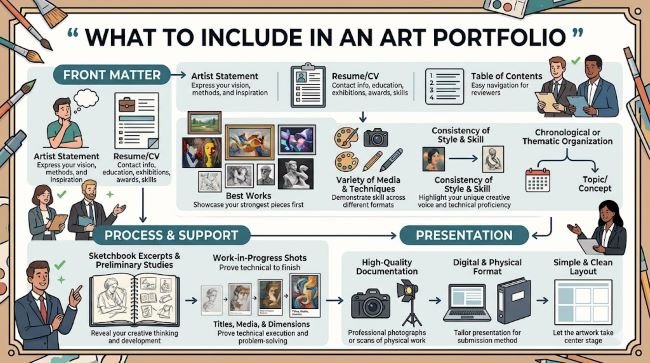
Putting together an art portfolio is one of those tasks that feels straightforward until you’re actually doing it. Suddenly you’re staring at years of work and have no idea what belongs, what order it should go in, or how much is enough. Knowing what to include in an art portfolio makes the difference between a collection that communicates who you are as an artist and one that just shows you made a lot of stuff. This guide walks through the whole thing: what goes in, what to leave out, and how to present it depending on your purpose.
Start With the Purpose of Your Portfolio
Before you pull a single piece, get clear on what the portfolio is for. The contents, the order, and the framing all shift depending on the audience.
The main contexts most artists build portfolios for:
- College or art school applications: Admissions reviewers want to see creative potential, range, and evidence that you can observe and think visually. Technical polish matters less than genuine curiosity and commitment.
- AP Art and Design submissions: The AP portfolio has a specific structure with a sustained investigation and selected works. It’s evaluated on a defined set of criteria, so it needs to align with those directly.
- Freelance or commercial work: Clients want to see work that resembles what they need. A graphic design client doesn’t need to see your life drawing studies; they need to see your design work.
- Gallery or exhibition applications: Curators look for a coherent body of work with a point of view. They want to see that you’re developing ideas over time, not just making individual pieces.
- Job applications in creative fields: Similar to freelance, but often with an emphasis on process and collaboration alongside finished work.
The rest of this guide covers all of these contexts, but the college and student portfolio situation gets the most attention because that’s where most people are starting.
How Many Pieces to Include
More is not better. A portfolio of 12 to 20 strong pieces consistently outperforms one with 30 pieces of varying quality. Reviewers notice when you pad. They remember the weakest piece as much as the strongest one.
For college applications, most programs ask for 10 to 20 pieces. Follow their specific requirements exactly, but if you have a range, lean toward fewer and stronger rather than more and inconsistent.
For AP Art portfolios, the College Board specifies the number of works required for selected works (typically 5 images showing sustained investigation). The requirements are precise, so check the current guidelines directly.
For freelance or job portfolios, 8 to 15 pieces is usually enough. Pick the ones most relevant to the type of work you want.
What to Include in an Art Portfolio for College
College admissions reviewers, especially at art schools, see hundreds of portfolios. Here’s what makes work stand out in that context and what to prioritize when deciding how to make an art portfolio for college.
Show observational work. Drawing from life, still life studies, figure drawing, and observational paintings demonstrate that you can see. This matters to almost every art and design program. Even if your primary interest is digital illustration or graphic design, including some observational work shows foundational skill.
Show your strongest work first and last. The pieces reviewers see first and last stick most in memory. Put a strong piece at the opening, maintain quality through the middle, and close with something memorable.
Show range, but keep it coherent. You want to demonstrate that you can work in more than one way, but a portfolio that jumps between completely unrelated approaches can feel unfocused. Look for a thread that connects the work, even if the media or subjects vary.
Include work that shows process, if possible. Some programs ask for process documentation: sketches, iterations, studies. Even when it’s not required, including one or two examples of how you develop an idea shows that you think, not just execute.
Don’t include everything. Leave out work you’re not confident in, work that was heavily guided by a teacher, and pieces that don’t represent where you are now.
Student Portfolio Examples: What Works and Why
Looking at student portfolio examples helps calibrate what’s actually expected at the high school and undergraduate level. A few patterns that appear in strong student work:
- A clear point of view. The work doesn’t have to be conceptually complex, but it should feel like it comes from a specific person with specific interests. A student who loves architecture and explores that through drawing, collage, and photography is more compelling than a student who tried ten different subjects without committing to any of them.
- Technical growth. Reviewers understand you’re a student. They’re not expecting fully professional work. What they want to see is evidence that you push yourself and that your skills are developing.
- Genuine subject matter. Work that’s based on things the student actually cares about reads differently from generic still lifes or landscapes made to fill a requirement. Personal connection to subject matter shows in the work.
- Presentation that doesn’t get in the way. Clean photography of physical work, consistent file sizes and formats for digital submissions, no distracting backgrounds or bad lighting. The presentation should be invisible so the work is what gets noticed.
AP Art Portfolio Examples and What the Sustained Investigation Means
The AP Art and Design portfolio has a specific component called the Sustained Investigation. This is a body of work developed around an inquiry, a question or idea you explored through multiple pieces over time.
Strong AP art portfolio examples share a few qualities:
- The inquiry is specific enough to generate real work but open enough to develop in multiple directions. “How does light change the emotional quality of familiar spaces?” works. “Art about my bedroom” is too literal; “identity and culture” is too broad.
- The individual pieces show variation within a consistent theme. You’re not making the same image repeatedly; you’re exploring the same question from different angles.
- The written component (the inquiry statement) is clear and matches what’s actually in the work. Reviewers read the statement and then look at the images. If the two don’t connect, it weakens both.
For AP and college preparation, looking at released examples from the College Board website gives you the most accurate picture of what meets expectations at each score level.
How to Make an Art Portfolio: Presentation Basics
Knowing what to include only gets you halfway. How you present it matters too.
For physical portfolios:
- Use a clean portfolio case that protects the work without overwhelming it
- Mount or mat work consistently if presenting originals or prints
- Photograph physical work in good natural light or with a proper setup to avoid glare, shadows, and distortion
- Include your name and contact information
For digital portfolios:
- Use a simple, clean layout that keeps the focus on the work
- High-resolution images (at least 1500px on the longest side for most screens)
- Consistent image sizing and cropping where possible
- Brief captions: title, medium, dimensions, and year
- Easy navigation with no broken links or missing files
For online portfolios and personal sites: Typography and layout choices on a portfolio site say something about your design sensibility even before anyone looks at the work. Clean, readable fonts that don’t compete with the imagery are the right call. A geometric sans like Source Sans Pro keeps things professional and neutral. For a more distinctive feel that still serves the work, something like Lato offers warmth without drawing attention away from the images.
What to Leave Out
This matters as much as what you include.
- Work you’re not proud of, even if it took a long time to make
- Old work that doesn’t represent your current skill level
- Pieces that were heavily corrected or guided by someone else
- Work that doesn’t connect to anything else in the portfolio
- Images with poor photography: blurry, badly lit, or with distracting backgrounds
- Too many pieces from the same series when two or three would make the point
The temptation to include more to show range is understandable, but a tight, confident selection reads as better judgment than a sprawling archive.
Key Takeaways
- The purpose of your portfolio determines what goes in it. College, AP, freelance, and gallery applications each need a different approach.
- Aim for 12 to 20 pieces for most contexts. Fewer strong pieces beat more average ones every time.
- For college portfolios, prioritize observational work, show range within a coherent thread, and put strong pieces at the start and end.
- Strong student portfolio examples share a clear point of view, genuine subject matter, and evidence of developing skill.
- AP art portfolio examples that score well have a specific, well-developed sustained investigation where the work and the written inquiry statement align.
- Presentation is part of the portfolio. Clean photography, consistent formatting, and legible layout all matter.
- Leave out anything you’re not confident in. Editing is a skill, and a tight selection demonstrates good judgment.