One way an author uses direct characterization is by telling the reader about the character through a narrator’s description, another character’s words, or a straightforward authorial statement. You’ve seen it a thousand times: “Maria was stubborn and proud.” That’s direct characterization in its simplest form. The author tells you who the character is. But most of the best fiction doesn’t rely on that alone. It layers direct statements with indirect characterization, letting readers piece together who a character really is through actions, dialogue, and behavior. Understanding how both work makes you a sharper reader and a better writer.
What Is Characterization?
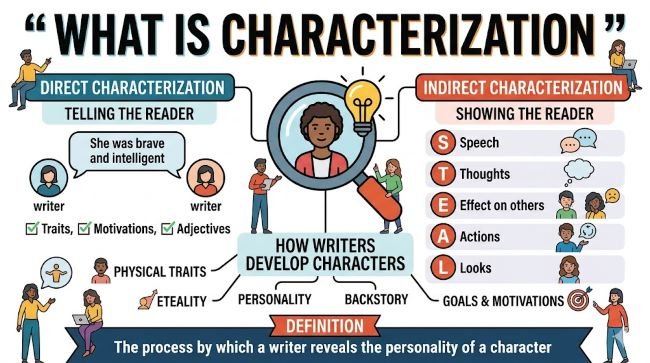
Characterization is the process an author uses to create and develop characters. It’s how a person on a page becomes someone you care about, fear, root for, or despise.
Every character needs to feel like a real person with consistent traits, motivations, and contradictions. Characterization is the toolkit for building that. It includes everything from a direct statement about a character’s personality to the way they hold a coffee cup when they’re nervous.
There are two main types: direct characterization and indirect characterization. Most writers use both, often in the same scene.
Direct Characterization: The Author Just Tells You
Direct characterization is when the author tells the reader explicitly what a character is like. No inference required. The information is handed to you.
One way an author uses direct characterization is by telling the reader about the character through:
- The narrator. A third-person narrator might describe a character as selfish, generous, hot-tempered, or calculating. The reader accepts this as fact within the story’s world.
- Another character’s dialogue. “Don’t trust him. He’s charming but he lies about everything.” That’s characterization delivered through speech.
- The character’s own self-description. A character might say “I’ve never been good at letting things go” and the author intends you to take that at face value.
- An authorial statement. In older fiction especially, authors would step in and directly tell the reader about a character’s nature, almost like an aside.
Direct characterization is efficient. It establishes facts about a character quickly and gives the reader a frame through which to interpret everything that follows. It works well at the start of a story when you need to orient the reader, or when you need to establish a contrast between what a character is told to be and what they turn out to be.
The risk with direct characterization is that it can feel flat if it’s all you use. Telling someone a character is brave is less powerful than showing them make a terrifying choice. That’s where indirect characterization does the heavy lifting.
Indirect Characterization: The Reader Does the Work
Indirect characterization requires readers to draw conclusions about a character based on evidence in the text rather than being told directly. The author shows; the reader interprets.
The standard framework for indirect characterization is sometimes called STEAL:
- S: Speech. What a character says and how they say it reveals personality, education, background, and values.
- T: Thoughts. Access to a character’s inner monologue shows what they really think versus what they present to others.
- E: Effect on others. How other characters react to someone tells you a lot about that person, even without a direct description.
- A: Actions. What a character does, especially under pressure, shows who they really are.
- L: Looks. Physical description, clothing, and how a character presents themselves can communicate personality, status, and self-image.
Indirect characterization examples from well-known fiction:
- A character who double-checks the door lock three times before leaving the house without any narrative comment about anxiety. The behavior tells you.
- A character who listens carefully to everyone at a dinner table, says very little, but later repeats something each person said at exactly the right moment. The reader concludes: this person pays attention and knows how to use information.
- A character who laughs at their own jokes before finishing them. The author doesn’t need to say they’re self-absorbed or socially unaware. The behavior does it.
Indirect characterization is more immersive because it puts the reader in an active role. You’re not being told how to feel about a character; you’re building that feeling from evidence. That investment makes characters feel more real.
Internal Conflict and What It Reveals About Character
An internal conflict features a character versus themselves. It’s one of the most powerful tools in both direct and indirect characterization because it shows the gap between who a character wants to be and who they actually are.
Internal conflict can be handled directly: “She wanted to speak up, but fear kept her silent. She hated herself for it.” The narrator tells you about the conflict explicitly.
It can also be handled indirectly: a character walks to the microphone at the town hall meeting, opens their mouth, closes it, and sits back down without speaking. The reader sees the conflict play out in action without being told what it means.
The best characterization often combines both. Direct statements set up what a character believes about themselves. Indirect characterization through action reveals whether that self-image is accurate. The tension between the two is often where the most interesting character work happens.
When to Use Direct vs Indirect Characterization
Neither method is better. They serve different functions and work best together.
Use direct characterization when:
- You need to establish a character’s traits quickly, especially early in a story
- You want to create a contrast between what is stated and what is shown
- An unreliable narrator’s direct characterizations of others reveals more about the narrator than the characters being described
- You’re writing in a genre or style where efficient storytelling matters more than deep immersion
Use indirect characterization when:
- You want the reader to form their own conclusions and become invested in the character
- You’re developing a complex character whose surface and depth differ
- You want to show growth or change over time through behavior rather than narration
- The scene is showing rather than telling, and you want the character work embedded in the action
Indirect characterization requires readers to:
- Pay attention to behavior, not just statements
- Notice patterns across multiple scenes
- Interpret subtext in dialogue
- Hold earlier characterization in mind and compare it to later behavior
This is part of what makes literary fiction feel rewarding to read. The reader is an active participant in building the character, not just a passive recipient of information.
Indirect Characterization Examples in Action
Here’s the same character moment written two ways:
Direct: “Jake was the kind of person who needed to be the smartest person in the room. He found it difficult to let anyone else finish a thought.”
Indirect: Jake waited until Priya was three words into her explanation before he started nodding and looking at his phone. When she paused, he finished her sentence for her, slightly wrong, and moved on.
Both convey the same information about Jake. The direct version tells you. The indirect version shows you and lets you form the judgment yourself, which means you’re more likely to believe it and remember it.
Strong fiction usually uses both. The narrator might give you the direct version early on, and then every scene after that demonstrates it indirectly until the trait feels completely real.
How This Connects to Writing and Design
Understanding characterization isn’t just useful for fiction writers. Anyone creating a brand voice, a persona, or a character for any kind of narrative content benefits from understanding how to balance telling and showing.
A brand that only describes its values directly (“We are innovative and human-centered”) without demonstrating those values through behavior is doing the equivalent of direct characterization with no follow-through. The indirect evidence, what the brand actually does, is what readers believe.
Typography and visual identity play a role here too. The fonts a brand chooses characterize it indirectly. A heavy, geometric display font like Gobold communicates directness and confidence without saying a word about it. A flowing script like Great Vibes communicates warmth and elegance through form, not statement. The reader or viewer draws the conclusion. That’s indirect characterization working at a visual level.
Key Takeaways
- One way an author uses direct characterization is by telling the reader about the character through a narrator, another character’s words, or a direct authorial statement.
- Indirect characterization requires readers to draw conclusions from a character’s speech, thoughts, actions, effect on others, and appearance.
- Direct characterization is efficient and useful for establishing facts quickly. Indirect characterization is immersive and builds deeper reader investment.
- An internal conflict features a character versus themselves and is one of the strongest tools for revealing who a character really is.
- Indirect characterization examples work by embedding character information in behavior and dialogue rather than stating it outright.
- The most effective characterization uses both methods, letting direct statements set up expectations that indirect behavior confirms, complicates, or contradicts.
Good character work is the difference between a story people finish and one they remember. Getting clear on how direct and indirect characterization function together is one of the most useful things any writer can understand.