“It was their final, most essential command” appears in George Orwell’s 1984 as part of one of the most disturbing passages in the novel. The full sentence reads: “And if all others accepted the lie which the Party imposed, if all records told the same tale, then the lie passed into history and became truth. Who controls the past controls the future: who controls the present controls the past.” The command being referenced is total psychological submission: not just obedience to the Party’s rules, but the surrender of your own mind’s ability to judge what is real. This post unpacks what that means, where it fits in the novel, and why it reads less like science fiction and more like a warning with each passing year.
Where the Quote Comes From in 1984
To understand “it was their final most essential command,” you need the context around it. George Orwell published 1984 in 1949, a novel set in a totalitarian future state called Oceania, ruled by a figure known as Big Brother and governed by a political organization called the Party.
The novel follows Winston Smith, a low-ranking Party member who works at the Ministry of Truth, an institution dedicated entirely to rewriting historical records to match whatever the Party currently claims is true. Winston secretly doubts the Party’s version of reality and begins keeping a diary, which is itself a thought crime.
The passage containing “it was their final most essential command” describes what the Party ultimately wants from its citizens. It isn’t enough to follow orders. It isn’t enough to publicly agree. The Party wants you to genuinely believe whatever it tells you, even when it contradicts what you saw with your own eyes an hour ago. That is the final command: not behavioral compliance, but the complete colonization of thought.
The Party Told You to Reject the Evidence of Your Eyes and Ears
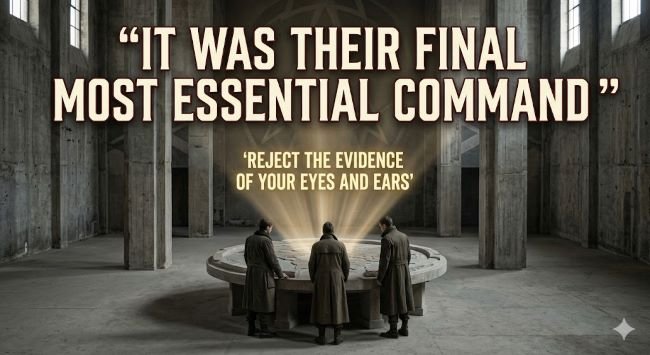
One of the most quoted lines from the novel connects directly to this idea: “The Party told you to reject the evidence of your eyes and ears. It was their final, most essential command.”
This sentence captures the mechanism by which the Party maintains power. Physical force matters, but it’s not sufficient for total control. People can endure physical punishment and still hold private beliefs. What the Party wants is something more complete: citizens who have genuinely lost the capacity to trust their own perception.
The logic is precise. If you reject the evidence of your senses, you have nothing left to use as a check against what you’re told. You become entirely dependent on the Party’s version of events. You can’t think your way toward doubt because the tool you’d use to doubt, your own mind’s ability to weigh evidence, has been handed over.
This is what makes the quote so durable as a piece of political writing. It identifies something real about how ideological control works at its most extreme: it doesn’t just suppress dissent; it aims to make dissent unthinkable.
Doublethink Meaning: The Mental Mechanism Behind the Command
The tool the Party uses to enforce this final command is doublethink. The doublethink meaning in the novel is specific: it is the ability to hold two contradictory beliefs simultaneously and accept both as true. More than that, it requires knowing that you are doing it while also genuinely not knowing.
Orwell describes it as “knowing and not knowing, being conscious of complete truthfulness while telling carefully constructed lies, holding simultaneously two opinions which cancelled out, knowing them to be contradictory and believing in both of them.”
Doublethink isn’t hypocrisy, where you know you’re saying one thing and believing another. It’s a trained mental state where the contradiction itself disappears from consciousness. The Party’s slogan captures it: War is Peace. Freedom is Slavery. Ignorance is Strength. These aren’t meant to be logical. They’re meant to be accepted without the question of logic arising.
In practice, doublethink is the mechanism that makes “it was their final most essential command” achievable. If you can be trained to hold contradictions without noticing them, the Party can change reality by decree, and you will update your beliefs accordingly without experiencing it as a change at all.
1984 Quotes That Surround This Idea
Several of the most remembered 1984 quotes orbit the same central theme of controlled perception and reality.
“Who controls the past controls the future. Who controls the present controls the past.” This is the Party’s operating theory of history. By controlling what records exist and what they say, the Party controls what people believe happened. And what people believe happened shapes what they think is possible in the future.
“Reality exists in the human mind, and nowhere else.” This is O’Brien’s statement to Winston during his interrogation, and it’s one of the most unsettling George Orwell quotes in the novel because it reveals the Party’s genuine philosophical position. They’re not pretending reality doesn’t matter. They believe that collective human agreement about reality is reality, and that by controlling agreement, they control everything.
“Freedom is the freedom to say that two plus two make four. If that is granted, all else follows.” Winston writes this in his diary as a kind of anchor to objective truth. The Party’s power depends on making even this basic assertion feel dangerous. If you can be made to doubt that two plus two equals four, you can be made to doubt anything.
“Power is not a means; it is an end.” O’Brien again, stripping away any pretense that the Party rules in order to achieve something else. The control is the goal. This is what makes 1984 different from ordinary political dystopias: the ruling party has no external justification. It rules because it has decided that ruling is the point.
Why This Still Matters
When Orwell wrote 1984, he was drawing on what he had observed: Stalinist Russia’s manipulation of historical records, the use of propaganda in wartime Britain, the way political language had been engineered to make certain thoughts harder to think. He was describing tendencies he saw in real institutions, not inventing a purely imaginary threat.
The novel’s durability comes from the precision of its analysis. It doesn’t just say that governments lie. It explains the mechanism by which sustained lying becomes sustainable: you have to get people to distrust their own perception more than they distrust the lie. Once that inversion happens, the liar is in control of reality.
“The Party told you to reject the evidence of your eyes and ears” is the clearest possible description of this inversion. It’s also the most practical test for whether it’s happening: when you find yourself unable to trust what you observed directly because an authority tells you it didn’t happen that way, that’s the dynamic Orwell was naming.
1984 in Visual and Design Culture
Orwell’s novel has had a significant influence on visual culture, from dystopian film aesthetics to political graphic design. The stark, utilitarian typography associated with authoritarian imagery in fiction draws directly from the aesthetic Orwell described: propaganda posters, stark slogans, the visual language of institutions that want obedience rather than engagement.
Typefaces carry that weight when used intentionally. A heavy, blocky display font like Ethnocentric captures the cold authority that characterizes the visual language of Orwell’s Oceania. For design work that wants to reference surveillance culture or political power, that kind of typographic choice communicates before a word is read.
On the opposite end, design that wants to push back against those aesthetics often reaches for something humanist and warm. A typeface like Kaushan Script signals individual voice and handcraft, values that are exactly what the Party in 1984 works to eliminate. The choice of type, like the choice of language, carries political meaning even when we don’t notice it consciously.
Key Takeaways
- “It was their final most essential command” comes from 1984 by George Orwell and describes the Party’s ultimate goal: not just behavioral obedience but the surrender of independent perception.
- The full context of the quote is “The Party told you to reject the evidence of your eyes and ears. It was their final, most essential command.”
- Doublethink meaning in the novel is the trained ability to hold contradictory beliefs simultaneously without noticing the contradiction. It’s the mental mechanism that makes the final command achievable.
- Key 1984 quotes around this theme include the Party’s theory of history, O’Brien’s statements about reality and power, and Winston’s defense of basic objective truth.
- Orwell drew on real political tendencies he observed, making the novel less a fantasy and more an analysis of how ideological control actually works at its extreme.
- The novel’s core insight is that the most complete form of political control doesn’t suppress thought. It makes certain thoughts impossible to form in the first place.
1984 remains in print and in conversation more than 75 years after its publication because the problem it describes hasn’t been solved. The question of how to protect your own capacity to judge what is real, against sustained pressure to surrender that capacity, is not a historical question. It’s a present one.